A gem budget you can actually check
Count materials, compare quotes, and separate a theoretical estimate from the amount you will actually spend.
Start with the decision, not the biggest number
Before buying materials, write down exactly what you want to compare: one finished gem against materials for a target tier, or an upgrade using a gem you already own. These are different budgets. A listing price is only an offer, not evidence that an item sells at that price. Record the server, item, tier, quantity and time alongside every quote. Keep item types separate: similar names do not make two materials interchangeable.
Use a transparent baseline
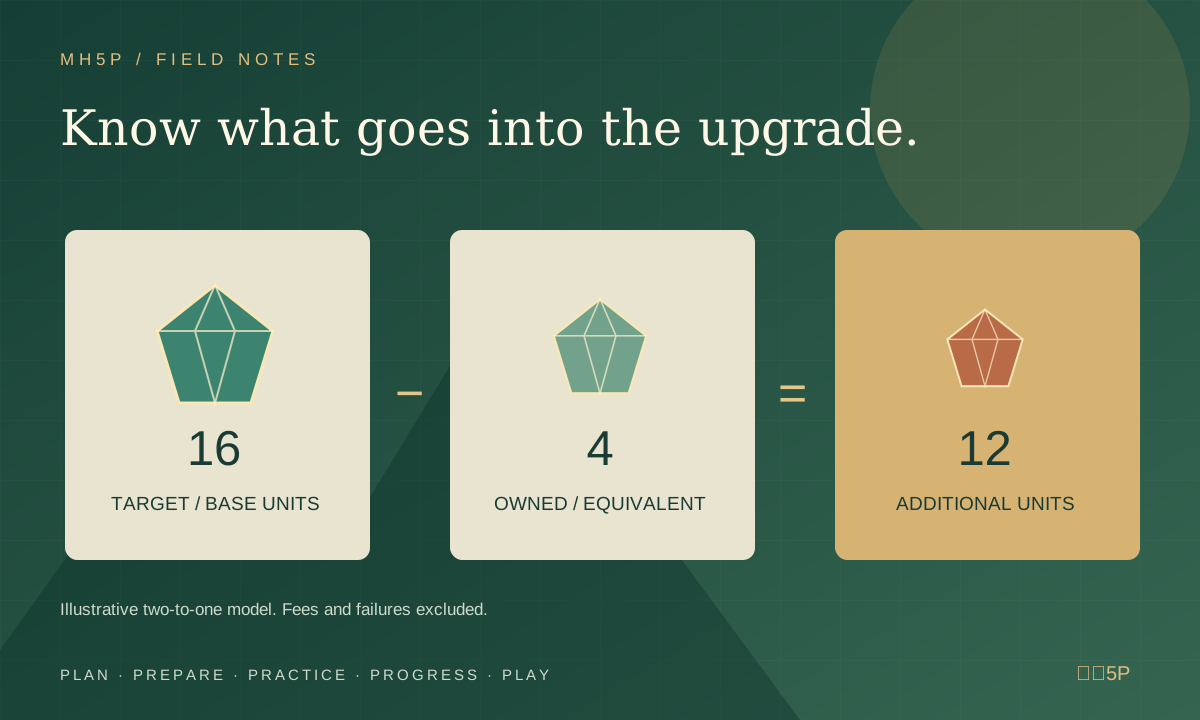
Our planner models an ideal two-to-one chain: two tier-1 units make one tier-2 unit, and so on. Under that assumption, a tier-L item represents 2^(L−1) tier-1 units. This is a mathematical model, not a promise about game rules, success rates or fees. Confirm that your actual item and current game version follow the assumed recipe before using the result. If the recipe differs, the result is not applicable.
Work through a small example
For a tier-5 target, the baseline is 16 tier-1 units. If you already own one tier-3 item, its modeled equivalent is four units, leaving 12 units to acquire. At an illustrative unit price of 30,000 silver, that means 360,000 silver in new materials. The 30,000 figure is an invented example, not a live market price. Enter your own quote in the calculator. With no existing item, the material total becomes 480,000 silver instead.
Separate cash spending from inventory value
An owned gem is not free in an economic comparison. It may reduce the cash you need today, but using it also means giving up whatever value you could recover by selling or using it elsewhere. Keep two lines in your notes: new spending and total resources consumed. This avoids declaring a route cheaper solely because some inputs were purchased earlier. If you cannot realistically sell an item, do not substitute a speculative listing price for its recoverable value.
Add the costs the formula cannot know
Compare the baseline with your real constraints: fees, recipe restrictions, failure risk where applicable, time spent collecting materials and the availability of a finished item. Do not invent a failure allowance without evidence. Instead, label unknown costs as unknown and revisit the comparison after checking the game interface. A narrow apparent saving can disappear once those factors are included. The most useful estimate is one whose assumptions you can explain.
Method & provenance
This is an original planning explanation. Examples are hypothetical, not live quotes or claimed in-game tests. Text and diagrams were produced with AI assistance. Check the current game interface and official announcements for actual game rules.
Fantasy Westward Journey official website · Editorial & corrections policy